

Swimming With Dugongs
Interdependent Origination


[O Andaman sea!]
What is the sacred? It is the ground of our being.
It’s the whole of which we are a part.
It’s what imbues our life with meaning and beauty.
– Joanna Macy, World As Lover, World As Self
Dear Dharma friends,
I want to talk about interdependence. A lot of us are suffering right now. I was thinking about how do we understand the dharma for ourselves, because that’s what we’re here for: to take in the teachings; decide if they’re bullshit; and if you proceed, digest them and integrate them into your life.
This idea of interdependence, if you can digest and understand it, is important. It is the worldview of Buddhism. Everything arises out of interdependence: emptiness, compassion, right action, ethical conduct, it all comes out of this crucial idea.
The whole phase is “interdependent origination.” It is from the Sanskrit, paticca samupadda.
That’s a mouthful. Every part of the translation is important. Let’s look at interdependent. It’s a skillful translation. Nothing comes into being on its own, singularly. When we are born, we are co-arisen from our parents. The web stretches further. We have the genes of our grandparents within us. We are shaped by our siblings and birth order. We can be shaped by our neighbors, the kids next door, the uncle who babysat us once.
In modern life we now understand that families are a system. Say you’re known in the family as “the good kid” who’s quiet and studious. That’s usually in response to a sibling or some family member who’s “the demanding one.” We arise in our temperaments, and how we’re perceived, within a dynamic.
In Buddhism we arise in particularity. We are not one. But we are part of a fabric that’s beyond what we could understand. We are part of an infinite net. We are downstream from infinite causes and conditions that give rise to—everything.
Self As Singular - ha ha ha!
If we look at the fiction of a self, who we are is shaped by our genes, our birth order, how our parents treat us. We are even shaped by the experiences our parents had in their childhoods. This can leap across countries and continents, and not just because of immigration. I come from a country where many kids of the upper class are raised by nannies. They’re profoundly shaped by a nanny who may have been raised in a different country, in a different language, and definitely a different class. That’s part of the co-arising that goes into this one child! How can we claim to be singular when so many circumstances go into making the “I” who talks and thinks and acts?
We’re talking about factors, some of which we comprehend, most of which we will never know. That’s paṭicca samuppada. I feel it is most useful to imagine as Indra’s divine net. We are the little lights at the interstices of the net. We are part of a system that connects to everything alive.
If we can understand this, if we can actually digest it, everything we do is changed. Karma arises out of Paṭicca Samuppāda. If we can remember ourselves as part of a profound fabric of infinite causes and conditions, we actually will, on our own, become careful about our actions, because we understand that our actions affect so many things beyond our comprehension.
And not just in this time but in time to come. To go back to the example of the family system, how we’re treating our kids for the next two years could be affecting our ancestors in 100 years. This is not theoretical. We are imprinting habits in the gene code. Things the babies of our great-great grand-babies will be scared of; experiences they will be drawn to; hobbies; their ways of being.
When we hold that view of time and interconnectedness, doesn’t that change how we play with the kids after dinner?
Result
If we are able to spend time pondering our place in Indra’s Net, we become humble. We are also, finally, in the right size. We do not dominate the system. We are a light, sure, but just one among many lights in a vast tapestry.
A lot of the time we’re moving around in our human society feeling lonely, because we think that we are singular and thus cut off. With paticca samupadda, we find we are not as lonely because we are in company with everything alive, and we’re in company across time. We find company in nature, too.
I’m struck by how many children understand their connectedness to other alive beings. There’s a moment when kids understand that meat comes from the death of an animal. It hurts them. They don’t think they are the animal (because we are not one)—but their sense of alive kinship extends beyond the confines of their relative body. I know multiple kids who are vegetarian, or who won’t eat certain animals, because that is their naturally-arising response. The kids aren’t doing this because of a rule of ethical conduct. The impulse comes from their hearts. They cannot eat animals. This is an example of how understanding paticca samupadda simplifies this walk of an ethical life.
Dugongs
I grew up in Thailand. I’m a tropical taco. My happy memories are from the South and the hours I spent in the Andaman, my favorite sea. My sister-in-law lives in Bangkok and she made a documentary about how dugongs are going extinct. I have not been able to make myself watch it. It touches on a grief too deep. Why? Because dugongs and their habitat are part of the fabric that is me. As a kid I kayaked in mangrove swamps and admired mudskippers. They are so ugly and so cute at the same time.
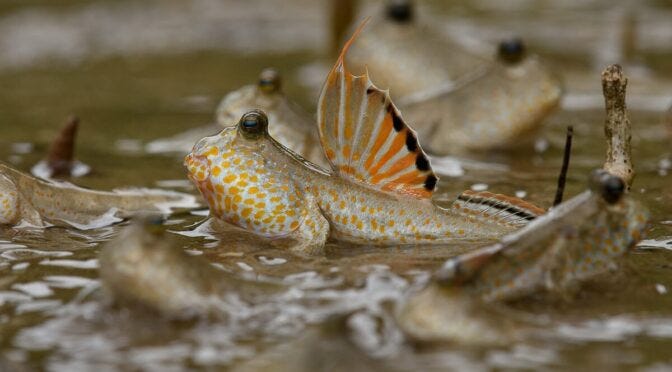
I tumbled off the back of the longtail boats when the boat captains said, “Go on.” They’d never say what they had spotted in the water, but I knew to keep my fins and mask on, to be ready. For that reason I have swum with turtles and dugongs, have jumped into inky water on the dark side of a limestone island and had it erupt into light (that was bioluminescence in Krabi).

In Thailand now, we’ve cut back mangrove forests so tourists can have pristine beaches. Without mangroves, beaches are being eroded in the ocean. The ocean is warming. Seagrass isn’t growing. And dugongs are washing up dead.
I can’t watch this short documentary. I want to support my sister-in-law. But I can’t seem to do it, because the turtles and dugongs and mangroves and mudskippers are a part of me.
Many people have this kind of relationship to a natural ecosystem if they spent part of their childhood outside. My husband feels this ways about the trees and creeks of the farm where he grew up. And that is good. That is healthy. We are right-sized in a fabric stretching in time and place and aliveness that goes beyond us.
Paticca samupadda is cultivating the view that we are a small node in Indra’s Net. Out of that comes this reverence for all of life. Reverence carries with it gentleness, humility, and a sense of connection that runs through our bodies. This brings so much relief! I’ll even call living with paticca samupadda inside a kind of purpose. When we hold this view, we can arise in our life’s purpose, whatever that will be, with integrity and alignment.
My hope is that we can all find our connection to the tapestry of paticca samupadda, whether we approach it psychologically or through nature. This view seems to me to be a crucial and stabilizing one to hold in the wild world we’re living in now.
What is the natural place you love? I’d like to hear. Drop me a note. If it is a natural place, that can be such an anchor in these times. The backdrop to my phone is one of my kids in the waters of the Andaman, the sea a bright glass green.
With love,
Sunisa
Links:
I teach live on Sundays from 10am- noon est at Heart Sangha in Philadelphia. All talks are broadcast for free on Zoom.
The full teaching calendar is here.
A residential Chod retreat is coming up soon. I am going to sing all four Chod ceremonies. Come, if this might be your lane.
Could you like, re-stack, drop a comment or interact in any way with this post, so people can find Dharma Bites?
And please consider upgrading to a paid subscription if you can support my work!
Postscript: I did watch the documentary and it is beautiful. So moving. As the Northeast of the US is buried in freezing winds and snow, you may enjoy time as a tropical taco. You can watch the video by clicking the image below. Go Mailee!
