

Big Self
living from the big heart of Buddhism

[This talk was delivered on Sunday July 7, 2024]
Dear Dharma friends,
I’d like to speak about some of the mythological aspects of Buddhism and try and put them into our everyday life.
I get asked about karma a lot.
When I was in my mid-twenties, I was on a silent Tibetan Buddhist retreat in the Himalayas. For a half-hour every day we had discussion sections. I was with this young English man. Every day he’d ask, with increasing desperation: “Can I be a Buddhist if I don’t believe in karma or reincarnation?” Our discussion leader would say: “You cannot. It’s not possible.”
What an interesting loop to get to observe. This poor guy! Maybe he had the idea of karma that Hollywood promotes, which is one that’s judgmental, as in “that’s your karma.” Such a karma flows from a Judeo-Christian worldview of sin and redemption. To be fair, karma has also been used to uphold caste in India, causing division, hatred, and oppression.
This is a corruption of Buddhist karma, which means, simply, action. Karma is a neutral word. Every action has a consequence. Not in a finger-wagging way, but more like a law, like gravity. You don’t have to believe in gravity for the apple to fall on your head. Action creates ripples. These flow from your intention and the physical action, which is why we apply mindfulness to our inner self and our outer self. The idea is to keep your actions as clean as possible. You don’t want to be living the consequences of your hate, fear, and destruction over many lives. How tiring! Better to live peacefully, in less karmic ripples.
This brings us to reincarnation, another slippery idea. Reincarnation is not really that I, Sunisa, was a worm in another life. There was no Sunisa-whale, or Sunisa-cat. That reifies “Sunisa,” creating a solid idea of self. Reincarnation is actually about loosening your grip on your sense of self. When I die, say I am buried in soil without a box. Maybe there will be a tree planted on top of my body. As the body decomposes it’ll become worm-fodder, maggot-feed. It would be a mistake to say that the tree is Sunisa, or the maggot. It’s more that my substance will be mixed into worm-substance. Perhaps part of my substance helps the tree grow. The tree is not “me.” There is no me-ness there at all.
Reincarnation is the quite-radical contention that we are connected to each other not in a woo-woo way, but literally. Our matter is made from the matter of other beings. Because of this, every plant, animal, and human is deserving of our reverence. We are each other. Hello, sacred life.
If, over the eons, we have been jumbled in the substrate of each other, we can love each other. We can feel gratitude for all living beings because inevitably they have been food, shelter, our partners, our parents, our children, our friends, our enemies.
From this foundation emerges the bodhisattva. Bodhi means awakening. 2,500 years ago in India, Prince Siddhartha sat under a tree and meditated, and when he attained enlightenment that tree was called the bodhi tree. Sattva is the body and being. It also means truth. The body is the seat of sacred truth.
So a bodhisattva is an awakened one. Like a Buddha they are no longer pulled by hope and fear. They vow to remain on earth for however long it takes for every sentient being to cross into the same freedom. Because of this, sometimes bodhisattvas are translated as enlightened action. They are the courageous ones.
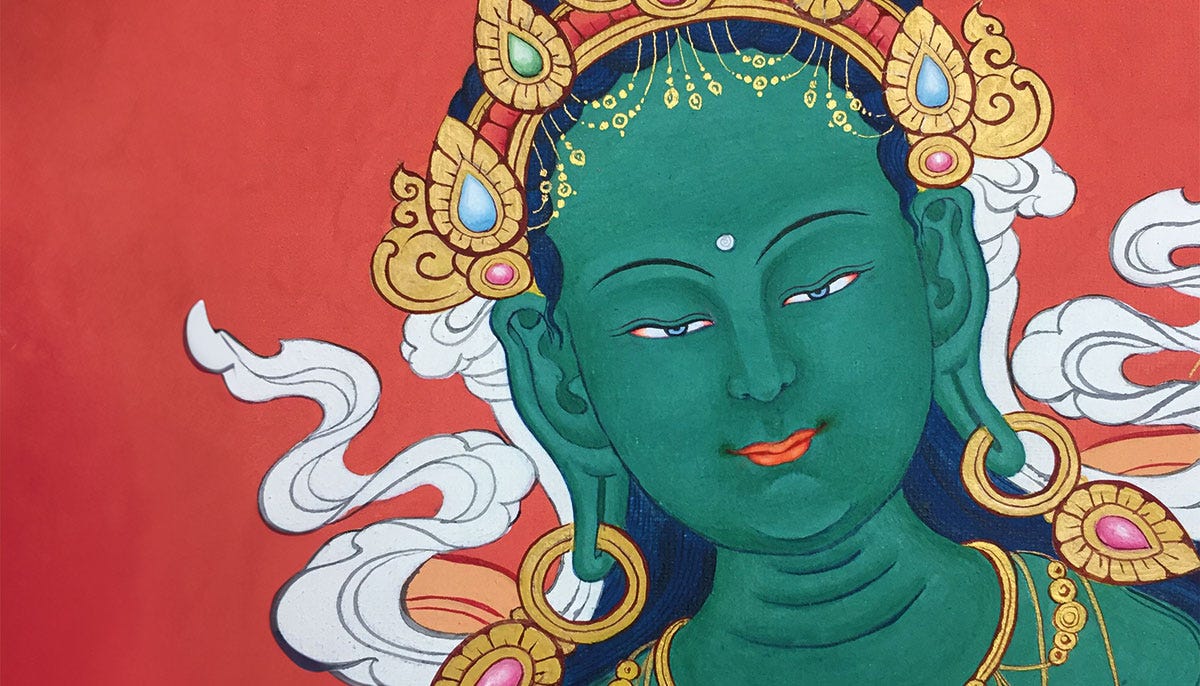
Some of the famous bodhisattvas are Avalokiteshvara, the bodhisattva of compassion, who has a thousand arms to help all beings. He is Chenrezig in Tibet and Guan Yin, and she, in China. There’s Green Tara, she who hears all cries. It's said that Tara was once born a princess who practiced the dharma. Urged by monks to take rebirth as male in the next life so she could further her practice, she said that gender is irrelevant, and vowed to come back in the female body in every lifetime, especially to help women because they face more obstacles. We can giggle that Buddhism saw the patriarchy, and that gender is a construct, circa 2500 years ago.
In recent years I noticed that Anam Thubten started to say “she’s a bodhisattva” in casual conversation. This broke my brain. I had never thought about bodhisattvas as actual people. Then my mind went to Dr Fauci in the pandemic, the way his humility and service in the face of fear, vitriol, and threats to him and his family seemed … unbelievable. There was this dignity to his being (and I don’t know him at all) that I found inspiring. That word seems even euphemistic to the level of gratitude that we can feel towards Dr Fauci. It’s more like—wow. Thank you. Perhaps we don’t deserve you, but we are so glad you’re here to see us through this period of alienation and turbulence.
I thought of Jon Baptiste, the musician. If you watch the documentary American Symphony you’ll see this quality in his being. This guy sings, “take a deep breath drink water,” so of course I am going to endorse him as a bodhisattva. But really, there is a radiant light that we can sense and be drawn to when we watch him.
It’s a beautiful thing to feel devotion to mythic bodhisattvas. I feel a particular affinity to Green Tara, and sing her mantra often. Bodhisattvas of the sky, as I shall call them, can inspire faith, humility, surrender. What they are ultimately meant to inspire is that you live as a bodhisattva. Tibetan Buddhism uses deity devotion not as an outside force, but to birth the Buddha or Bodhisattva within.
The next question is, how do we start to become a bodhisattva? As with all things in Buddhism, it begins with your intention. You want to cultivate the awakened heart, bodhicitta. This is the transcendent aspiration to be here for all beings, in all eons, until everyone has found freedom from the turbulence of samsara, which is being pulled by attachment and aversion.
There’s the bodhicitta of a king: Me first. You can cross after me. There’s the bodhicitta of a captain: I’ll navigate. We’ll go together. And the bodhicitta of a shepherd: You first! And you! Did I miss anyone?
Bodhicitta is treating everyone like your kids. I taught high school in the pandemic, and you can imagine that my students were having an excruciating time. They needed contact with their peers, which was just what they couldn’t do. I was in so many counseling sessions. There were so many parents clawing their way through each day. I also had a toddler experiencing his own turbulence as the world of emotions collided in his little body. One day, in Zoom class, I accidentally reacted to one of my students the way I did to my toddler: my face broke apart; I emoted goopy sounds; I let my heart show.
This kid’s face broke apart in their Zoom box. They turned their face up, and admitted a difficult thing that did not make them sound particularly smart, or Ivy-ready. They were right there, a tender little bean waiting for someone to make contact.
When you're a parent, if you’re really doing it, your heart changes towards other babies who are the same age as your babies. Then, all babies. Babies in hunger. Babies in poverty. Babies in war. It becomes unbearable and vital that your heart expand to take in so much suffering. There is an urge to witness the suffering, and an urge that arises to meet it which says, I Must Help.
This is what we're aiming for. Bodhicitta is the quality of love that makes your eyebrows sizzle. It's bigger than you think.
Infinite, in fact.
Sunisa